
Is hair transplant an option for women?
Hair loss in women is more common than many realise, yet it is often misunderstood. Many women assume that a hair transplant is not suitable for them or will not give natural results.
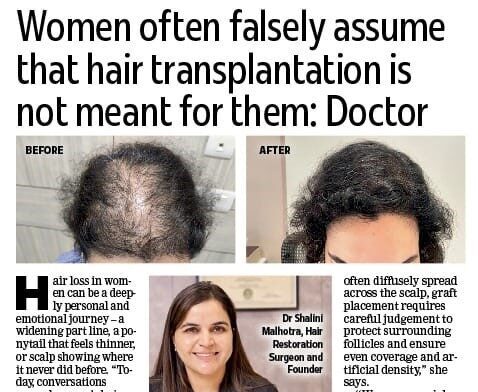
Today, awareness is improving, and more patients are exploring medical solutions for female hair thinning. Among these, hair transplant for women is increasingly recognised as a viable option when planned correctly.
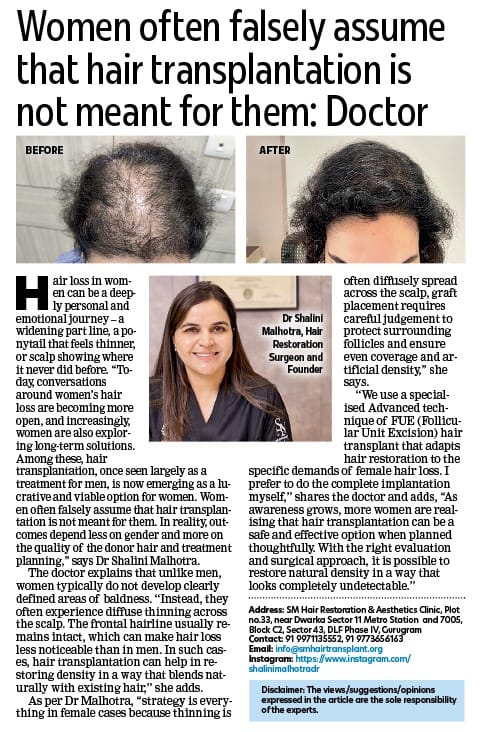
Dr. Shalini Malhotra, hair restoration surgeon and founder of SM Hair Restoration & Aesthetics Clinic, was recently featured in The Times of India, where she discussed how modern hair transplant techniques are changing the approach to female hair loss.
Featured in The Times of India
Why more women are considering hair transplant
Hair loss in women often presents as diffuse thinning rather than visible bald patches. A widening part line, reduced volume, or scalp visibility are common early signs.
“Women often assume their options are limited, or that hair transplantation is not meant for them,” says Dr. Shalini Malhotra. “In reality, outcomes depend less on gender and more on the quality of the donor hair and treatment planning.”
In suitable cases, a hair transplant can restore density in a way that blends naturally with existing hair.
How hair transplant for women is different
Unlike men, women usually retain their frontal hairline and experience thinning across a larger area. This makes treatment more complex, as existing hair must be preserved while improving density.
“Strategy is everything in female cases,” Dr. Malhotra explains. “We assess donor strength and long-term hair loss patterns, then place grafts in a way that creates natural fullness rather than artificial density.”
Advanced techniques for natural results
Dr. Malhotra uses a specialised Advanced FUE technique that adapts hair restoration to female hair loss patterns, allowing precise control over graft placement and density.
She also offers an unshaven hair transplant option for suitable candidates, so the procedure can be done without cutting visible hair — an important consideration for many women.
Who is a suitable candidate
Hair transplant for women is not suitable in every case. The decision depends on:
- donor hair quality
- pattern and stability of hair loss
- overall scalp health
Women with traction alopecia, thinning along the hairline, or areas of permanent hair loss may benefit most.
What results can you expect
Hair transplant results are gradual. Transplanted hair sheds initially, followed by regrowth over several months. Most patients see visible improvement between 6–12 months.
The goal is natural-looking density that blends with existing hair, rather than a dramatic change.
When to consider treatment
If you are experiencing hair thinning, early evaluation helps determine the right approach. Not all patients require surgery — medical treatments may be recommended in some cases.
A personalised consultation ensures the most appropriate treatment plan.